Greg Stanley

Postdoctoral Scholar · University of Washington

Greg Stanley

I'm a postdoctoral scholar in computer science at the University of Washington, working with Max Kleiman-Weiner on computational moral psychology and AI safety.

About

Morality, made computable

I'm on a mission to maximize the flourishing of sentient life. I created an online multiplayer Morality Game experiment platform to consolidate and expedite scientific progress towards learning how to increase cooperation. I'm developing a unified computational model of moral psychology and tool for AI alignment, called the Tripartite Moral Architecture that integrates insights from various ethical traditions. Specific topics include moral responsibility, value learning, ethical dilemmas, deception and self-deception, act-person dissociations in moral judgment, higher-order Theory of Mind, and cultivating moral excellence.

I joined Max Kleiman-Weiner's Computational Minds and Machines Lab as a postdoctoral scholar in September 2026. One of my first projects is a computational model of moral character, and of how to cultivate the character of others, inspired by virtue ethics: the tradition in ethical philosophy that centers moral judgment on the agent, rather than on actions or outcomes.

I earned my PhD in Psychology (Cognition and Cognitive Neuroscience) at the University of Michigan in 2025, advised by Rick Lewis and Jun Zhang, after a BA in Cognitive Science at UC Irvine. Along the way I taught myself to code, so I could build the instrument my questions needed.


Research

Questions I work on

Spinoza wanted ethics as rigorous as geometry, and Leibniz dreamed that people who disagree could one day sit down and say, "Let us calculate." Centuries later we still have nothing like it, and few people notice the hole that leaves. I think a moral framework should work like a scientific theory. It should be precise enough that you can enter your foundational values and a situation and get back what you ought to do. And like any good theory, it should be fallible, open to conjecture and criticism. With one, people and AIs could reach a coherent and consistent set of principles far faster, with much less room for plausible deniability and self-deception. It would also sharpen reflective equilibrium, the method of adjusting principles and judgments about particular cases against each other until they agree, because a precise framework shows exactly what each principle commits you to. Artificial agents need one as much as we do, and the questions below are ones an aligned AI must answer too: what people value, how they reason about one another, and who is responsible when harm runs through a chain of choices.

Theory of mind

How does reasoning about other minds break down?

Planning around other people means thinking about what they think you will do. A perfect reasoner is easy to model, but finite minds can't always reason that far, and the harder question, where models disagree, is how their reasoning breaks down. I used time pressure to induce failures in this recursive mentalizing. Contrary to the predictions of a rival model, when people couldn't reason through the full tree of possible choices, they failed to represent the preferences of the final decision-maker, as if treating their choice as the roll of a die.

Strategic reasoning under pressure →

Value learning

How do we read motives we cannot see?

We infer the motives of others by watching the choices they make. But how can we know who to trust when their motives are hidden and multiple motives are consistent with the same choice? Participants played simple economic games with randomized payoffs repeatedly with the same counterparts, alternating roles as the one choosing and the one predicting the choices of their counterparts. We modeled this inference as Bayesian learning, and we ran the largest-to-date model comparison of 526 utility functions to find the utility function that best expressed participants' moral motives like self-interest, altruism, and envy. The winner held a surprise: most people disliked being ahead of a stranger more than being behind, the reverse of the standard assumption.

Inferring Hidden Motives →

Responsibility

Do enablers hide behind those who carry out harm?

Who do you blame more? A harasser who shows up at someone's house or the doxer who posted their address online? In a preregistered experiment, I found that when multiple actors are jointly responsible for a harm, the causally proximate agent deflects blame from the distal agent, who ultimately enabled the proximate agent and made the harm possible. After controlling for the foreseeability and preventability of the harm, this “responsibility shielding” effect only occurs when the proximate agent is a fit target of attributions of moral responsibility: they are a sane, capable adult, not a child or someone mentally impaired. This dynamic appears in drug supply chains, negligent entrustment, gun sales, online platforms and military chains of command, and it may soon shield anyone who deploys an artificial intelligence agent that seems to choose for itself.

Responsibility shielding →

Moral judgment In development

Can the great moral theories share one mind?

Ethical philosophy is splintered into warring camps, often assumed to be irreconcilable: consequentialism centers moral judgments on outcomes, deontology centers moral judgments on actions, and virtue ethics centers moral judgment on the actor. Yet, most non-philosophers care about all three when resolving moral dilemmas in their everyday lives. They focus on the result, the means to achieve that result, and what one's behavior implies about their moral character.

The Tripartite Moral Architecture is a synthesis of all three. Tune its parameters and it can become a pure consequentialist, deontologist, virtue ethicist, or an amalgam of all three, describing most people. As a unified model, it aims to encapsulate a wide variety of moral psychology phenomena in a coherent, interpretable way. For AI, the aim is a value system written in the open, one you can inspect, adjust and audit, instead of values buried in a network's weights.

Where this is going, on the About page →

The platform

The Morality Game: a video game for science

I created the Morality Game, an online multiplayer platform where people can play for real cash inside dilemmas drawn as game trees, making choices and predicting one another's choices. Researchers build a study in a web dashboard rather than in code, or describe a dilemma in plain words and let a language model draft it as a game tree. Every study is saved in one shared format, so studies can be compared, combined and re-run.

Every game tree also has coordinates on factors that bear on cooperation, such as how far the players' interests align and how much control each one has, so every study takes its place on one shared map.

I led a team of fourteen undergraduate research assistants at Michigan to build it. It ran the experiment in my Cognition paper and part of Inferring Hidden Motives, and it is the testbed for my models of moral judgment.


Publications

Papers

Peer reviewed · Cognition · 2026

Strategic reasoning under pressure: Testing heuristics in higher-order theory of mind

Gregory N. Stanley

I tested two models of how reasoning about other minds degrades. In the Blind Spot Model, a strained mind leaves a distant outcome out of its picture; in the Near Sight Model, it keeps every outcome but treats the last choice as a coin flip. In 32 games with eight seconds for the first move, mistakes fell where Near Sight predicted, not where Blind Spot did.

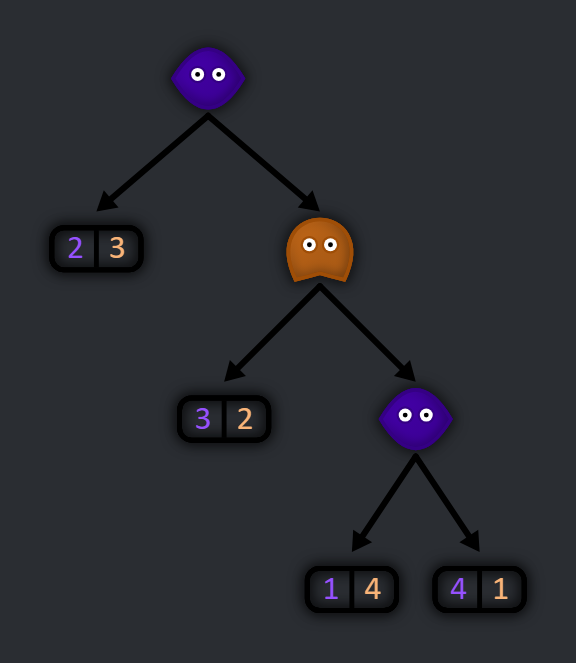
A three-step game tree: a purple player chooses, then an orange player, then the purple player again, with payoffs at each ending

The game as it is

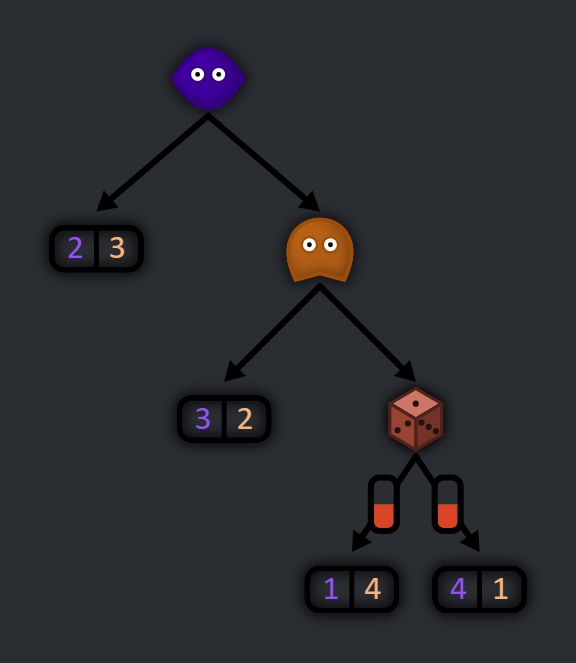
The same game tree with its last choice replaced by a die, each outcome given equal odds

The same game, as a strained mind represents it

One game from my Cognition paper. The left is the game itself, as players saw it on screen. The right is not a screen at all but a mental representation: the same game as a strained mind holds it once it can no longer reason all the way to the end. The die marks that mind's failure to represent the last player's preferences, and so their choice probabilities: unable to tell which ending that player would pick, it treats each as equally likely. Across the paper's 32 games, mistakes fell where this blurring heuristic predicted.
↓ Go deeper↑ Show less

Thinking about thinking about thinking is core to gossip, sarcasm, romance, dramatic irony, and nuclear deterrence, but it is really hard to do. It requires more mental resources than finite minds often have available. Every model of this recursive mentalizing agrees on how it should work when it works perfectly, but models disagree about how this reasoning breaks down.

I created a contest between two rival models, where the winner correctly predicted the distribution of errors across 32 time-pressured alternating-choice games that varied only in their payoff structures. In nondiagnostic games, the optimal choice for lower- and higher-order reasoners is the same, while in diagnostic games, the optimal choice for lower- and higher-order reasoners is opposite. Diagnostic games are harder because they require participants to overcome their shallow thinking to make the best move, and thus diagnostic games result in more errors. But the two models disagreed about which games to classify as diagnostic or nondiagnostic, with eight classified as nondiagnostic by both, eight classified as diagnostic only by one model, eight classified as diagnostic only by the other model, and eight classified as diagnostic by both. This disagreement meant differing predictions about which games would lead to more errors.

Seventy-three University of Michigan students played the games. The Blind Spot Model lost. As if blind to specific branches, it modeled shallow reasoning as manifesting in the inability to represent entire branches of the tree. The Near Sight Model won. As if deeper branches become blurrier, it modeled shallow reasoning as manifesting in the inability to represent the preferences and decision making of the final chooser, much like swapping a choice node for a chance node: a random event. More than half of first moves were mistakes in the games it classified as diagnostic, against about a third in the rest.

This result provides modelers a more accurate way to model multi-step social reasoning, and the method provides a clear way to diagnose shallower versus deeper recursive mentalizing.

Cite

APA · for Word and Google Docs

Stanley, G. N. (2026). Strategic reasoning under pressure: Testing heuristics in higher-order theory of mind. Cognition, 266, Article 106331. https://doi.org/10.1016/j.cognition.2025.106331

BibTeX · for LaTeX and reference managers

@article{stanley2026strategic,
  author  = {Stanley, Gregory N.},
  title   = {Strategic reasoning under pressure: {T}esting heuristics in higher-order theory of mind},
  journal = {Cognition},
  volume  = {266},
  pages   = {106331},
  year    = {2026},
  doi     = {10.1016/j.cognition.2025.106331}
}

Word · for its source manager

Download

All five works. In Word: References, Manage Sources, Browse, choose this file, then Copy the ones you want.

Preprint · arXiv · 2026

The Morality Game: An online multiplayer platform to standardize, expedite, and expand research on cooperation

G. N. Stanley, A. Yang, L. Tsimhoni, R. Wang, E. Arramreddy, R. Desai, S. Pan, M. Ahn, V. G. Moorthy, W. Mathias, M. Xu, J. Kessler, Y. Xing, Y. Li, D. Bian

Studies of cooperation are hard to rerun exactly and harder to combine, because each one is built its own way. We describe the Morality Game, an online multiplayer platform where researchers build studies from game trees in a dashboard, without code. Every tree has coordinates on factors such as how far the players' interests align, so each study becomes one more condition in a single, growing experiment.

↓ Go deeper↑ Show less

A methods section often lacks the detail needed to rerun a study, and a meta-analysis must first reconcile every study's own procedures. Tools such as oTree and PsychoPy can build far more kinds of experiment than ours can, but the freedom to vary everything is also what makes their results so hard to compare.

The Morality Game trades that freedom for a smaller infinity: less a box of Legos than a model airplane kit, where whatever parts you choose, you get a viable airplane. Its game trees are the branching diagrams of game theory, in which each fork is someone's choice or a roll of chance, and players predict one another's choices. The platform runs each study and stores its data in one standard format, and a replicate button copies a study's complete settings into another researcher's dashboard.

Besides how far the players' interests align, the factors include how unequal the outcomes are and how much control each player has. Researchers can build a tree and let the platform find its coordinates, or name the coordinates and let it build the tree. So results accumulate instead of scattering: two studies can differ by exactly one factor, and even a randomly configured study will likely yield data worth keeping. The aim is a landscape of cooperation, with peaks where it flourishes and valleys where it fails, checked against field studies outside the game.
Cite

APA · for Word and Google Docs

Stanley, G. N., Yang, A., Tsimhoni, L., Wang, R., Arramreddy, E., Desai, R., Pan, S., Ahn, M., Moorthy, V. G., Mathias, W., Xu, M., Kessler, J., Xing, Y., Li, Y., & Bian, D. (2026). The Morality Game: An online multiplayer platform to standardize, expedite, and expand research on cooperation. arXiv. https://doi.org/10.48550/arXiv.2606.24037

BibTeX · for LaTeX and reference managers

@misc{stanley2026moralitygame,
  author        = {Stanley, Gregory N. and Yang, Alan and Tsimhoni, Liam and Wang, Roujia and
                   Arramreddy, Ekdatha and Desai, Rohan and Pan, Shulin and Ahn, Michael and
                   Moorthy, Vijairam G. and Mathias, William and Xu, Mai and Kessler, James and
                   Xing, Yahan and Li, Yang and Bian, Duoming},
  title         = {The {M}orality {G}ame: An online multiplayer platform to standardize, expedite,
                   and expand research on cooperation},
  year          = {2026},
  eprint        = {2606.24037},
  archivePrefix = {arXiv},
  primaryClass  = {q-bio.NC},
  doi           = {10.48550/arXiv.2606.24037},
  url           = {https://arxiv.org/abs/2606.24037}
}

Word · for its source manager

Download

All five works. In Word: References, Manage Sources, Browse, choose this file, then Copy the ones you want.

Preprint · PsyArXiv · 2026

Responsibility shielding: When causally proximate agents deflect blame for distal enablers

Gregory N. Stanley

When a gun store owner sells a rifle to a customer he suspects is planning a mass shooting, how much of the blame for the shooting is the owner's? In a preregistered experiment with 282 participants, an enabler drew less blame when a responsible person carried out the harm than when a machine or a man with a severe brain injury did, though he foresaw the same risk and could have stopped it every time.

The experiment's three designs. An enabler can make a harm possible and expects it to follow three times in four. Between that choice and the harm stands a responsible person (Choice-Choice), chance (Choice-Chance), or nothing at all, because a second person decides at the same moment without seeing the enabler's choice, and the harm follows only if both act (Division). Click the figure to see the designs as the platform draws them.
↓ Go deeper↑ Show less

A scammer clones a granddaughter's voice and sends a courier to collect her grandfather's cash. Does the scammer deserve less blame when the courier is in on it than when he is an unwitting gig worker? The same question shapes who answers for opioid marketing and platform design, where enablers say it was someone else's choice.

The participants, University of Michigan undergraduates who passed every comprehension check, judged Clark, who is paid $2,000 for enabling a harm he expects to follow three times in four, such as arming a firework canister for a buyer likely to set it off over a crowd. Only the other link in the chain changed.

When that link was a responsible person, participants blamed Clark 1.03 points less, on a nine-point scale, than when it could not be held responsible: a buyer with a severe brain injury or, in a trolley version, a computerized switch. He also drew 0.67 points less blame than when another person chose at the same moment, unaware of his choice, which suggests shielding is more than blame split two ways. The core effect appeared in both stories. I suspect we trace backward from a harm and let blame settle on the first person who could answer for it, a shortcut that can misfire when technology gives enablers as much foresight and control as anyone downstream. Artificial intelligence agents that seem to choose for themselves may shield whoever deploys them. Whether enablers deserve that discount is the harder moral and political question.

Cite

APA · for Word and Google Docs

Stanley, G. N. (2026). Responsibility shielding: When causally proximate agents deflect blame for distal enablers. PsyArXiv. https://doi.org/10.31234/osf.io/yzb75_v3

BibTeX · for LaTeX and reference managers

@misc{stanley2026shielding,
  author    = {Stanley, Gregory N.},
  title     = {Responsibility shielding: When causally proximate agents deflect blame for distal enablers},
  year      = {2026},
  publisher = {PsyArXiv},
  doi       = {10.31234/osf.io/yzb75_v3},
  url       = {https://osf.io/preprints/psyarxiv/yzb75_v3}
}

Word · for its source manager

Download

All five works. In Word: References, Manage Sources, Browse, choose this file, then Copy the ones you want.

Preprint · arXiv · 2025, revised 2026

Inferring Hidden Motives: A Utility Bayesian Model of learning the values of others

Gregory Stanley, Jun Zhang, Rick Lewis

We model how people learn what others value from their choices, as graded Bayesian beliefs that sharpen with every choice. This fit participants' predictions better than simpler learners and more than 15,000 models that sort others into types. Among 526 candidate utility functions every classic model ranked 255th or worse, and fitted with the winner, most people disliked being ahead of a stranger more than being behind, reversing the canonical ordering.

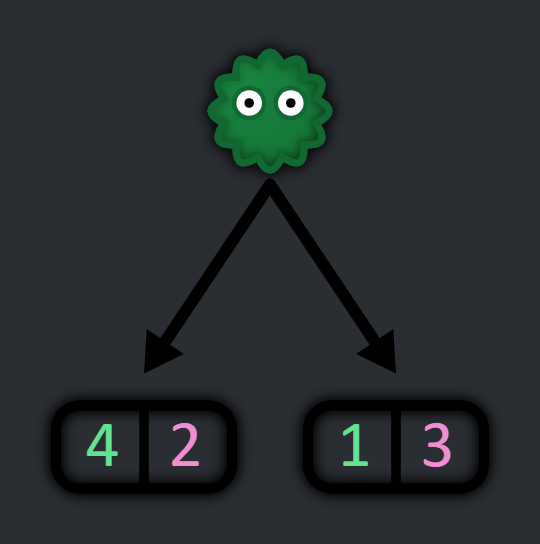
Game tree: a green player chooses between keeping 4 points and giving the pink player 2, or keeping 1 and giving 3
One of the study's games, as the platform draws it. The green player chooses between two ways of splitting points, and the pink player predicts the choice. One choice can come from different motives, such as self-interest, generosity or a wish to come out ahead; many choices, across games with randomized payoffs, tell them apart.
↓ Go deeper↑ Show less

Cooperation depends on judging whom to trust, yet motives are invisible: the same choice can come from generosity, a wish to come out ahead, or indifference to the other person, and misreading it can mean being exploited.

The learner's beliefs are about how much someone weighs their own payoff, their partner's, and being ahead or behind. In two online experiments, with 83 and 73 participants, people predicted a partner's choices between two ways of allocating points. In the second, which ran on the Morality Game, everyone also took turns choosing, so we could measure each person's preferences and their expectations of others, and payoffs drawn at random from all 625 possible games pulled apart motives that hand-picked games blur together.

In the first experiment, the type models' loss showed that people place others on a continuum, not in categories. Fitted with the winning utility function, people's choices showed self-interest far outweighing kindness toward strangers, and about a third of people weighted a stranger's payoff negatively. Yet at first they expected others to mind being behind more than being ahead, the opposite of their own ordering. Inferring what others value is a capacity we will want not only in ourselves but in the artificial agents we build.


Cite

APA · for Word and Google Docs

Stanley, G., Zhang, J., & Lewis, R. (2025). Inferring hidden motives: A utility Bayesian model of learning the values of others. arXiv. https://doi.org/10.48550/arXiv.2511.07825

BibTeX · for LaTeX and reference managers

@misc{stanley2025hiddenmotives,
  author        = {Stanley, Gregory and Zhang, Jun and Lewis, Rick},
  title         = {Inferring {H}idden {M}otives: A {U}tility {B}ayesian {M}odel of learning the values of others},
  year          = {2025},
  eprint        = {2511.07825},
  archivePrefix = {arXiv},
  primaryClass  = {q-bio.NC},
  doi           = {10.48550/arXiv.2511.07825},
  url           = {https://arxiv.org/abs/2511.07825}
}

Word · for its source manager

Download

All five works. In Word: References, Manage Sources, Browse, choose this file, then Copy the ones you want.

Dissertation · University of Michigan · 2025

Social Rationality: Social Preference and Strategic Reasoning in Social Contexts

Gregory N. Stanley · advised by Rick Lewis and Jun Zhang

Classical theory judges rationality by how well we pursue our goals, not by what they are. My dissertation asks what that pursuit looks like when the goals include other people: how we weigh their outcomes, infer their motives from their choices, and reason about their reasoning. People tracked one another's motives as matters of degree, not types, and under time pressure they blurred distant moves instead of ignoring them.

↓ Go deeper↑ Show less

Caring about a stranger is no less rational than caring only about yourself; what matters is how people pursue such goals.

In repeated games where one player picks between two ways of splitting points with another, people predicted each partner's next choice. A Bayesian learner with graded beliefs about motives fit those predictions better than models that never update, models that remember only the last choice, and more than 15,000 models that sort people into types. Comparing 283 candidate utility functions favored separating two motives that standard two-dimensional measures merge: caring about a partner's payoff, and comparing your payoff with theirs. A later paper, Inferring Hidden Motives, extends the comparison to 526 forms and revises several findings. In the study behind my Cognition paper, students played 32 three-step games with eight seconds for the first move. More than half of first moves went wrong where the blurring model predicted trouble, about a third elsewhere.

The common thread is that social reasoning comes in degrees, not switches. The final chapter sketches one agent that does all three, to be tested on the Morality Game, the platform I created for this work.

Cite

APA · for Word and Google Docs

Stanley, G. N. (2025). Social rationality: Social preference and strategic reasoning in social contexts [Doctoral dissertation, University of Michigan]. Deep Blue Documents. https://doi.org/10.7302/26857

BibTeX · for LaTeX and reference managers

@phdthesis{stanley2025social,
  author = {Stanley, Gregory N.},
  title  = {Social Rationality: Social Preference and Strategic Reasoning in Social Contexts},
  school = {University of Michigan},
  year   = {2025},
  doi    = {10.7302/26857}
}

Word · for its source manager

Download

All five works. In Word: References, Manage Sources, Browse, choose this file, then Copy the ones you want.


Teaching and mentoring

Building scientists, not just studies

At Michigan I designed and taught a capstone seminar, Multiplayer Decision Science: The Psychology of Cooperation and Morality, in which students designed and ran their own multiplayer experiments, analyzed the data with game theory and computational models, and presented their findings at a mock academic conference. I taught for seven years as a graduate student instructor and lecturer, in courses including Introduction to Cognitive Psychology, Decision Science and Research Methods.

I also led the fourteen undergraduate research assistants who built the Morality Game with me. They are co-authors on the platform paper, and you can meet them on the Team page.


Recent

News


Beyond the lab

The long way here

In high school I went around asking classmates where they stood on moral questions, from political ones like gay marriage, abortion and the death penalty to everyday ones like sex before marriage, downloading music without paying, and what counts as cheating on a partner. Their views were strongly held, yet often seemed to come from nowhere, and when I searched for answers of my own I sometimes came up empty. I hated feeling lost like that. Utilitarianism and open-mindedness became my guiding stars, a binary pair, each held in the other's orbit. Open-mindedness meant testing utilitarianism against the traditions I argued with most, deontology and virtue ethics, and asking whether they could be made precise. That led somewhere I didn't expect: no finite mind can weigh consequences into the infinite future, so it needs rules of thumb and good character to steer by. Years later, that idea became the Tripartite Moral Architecture.

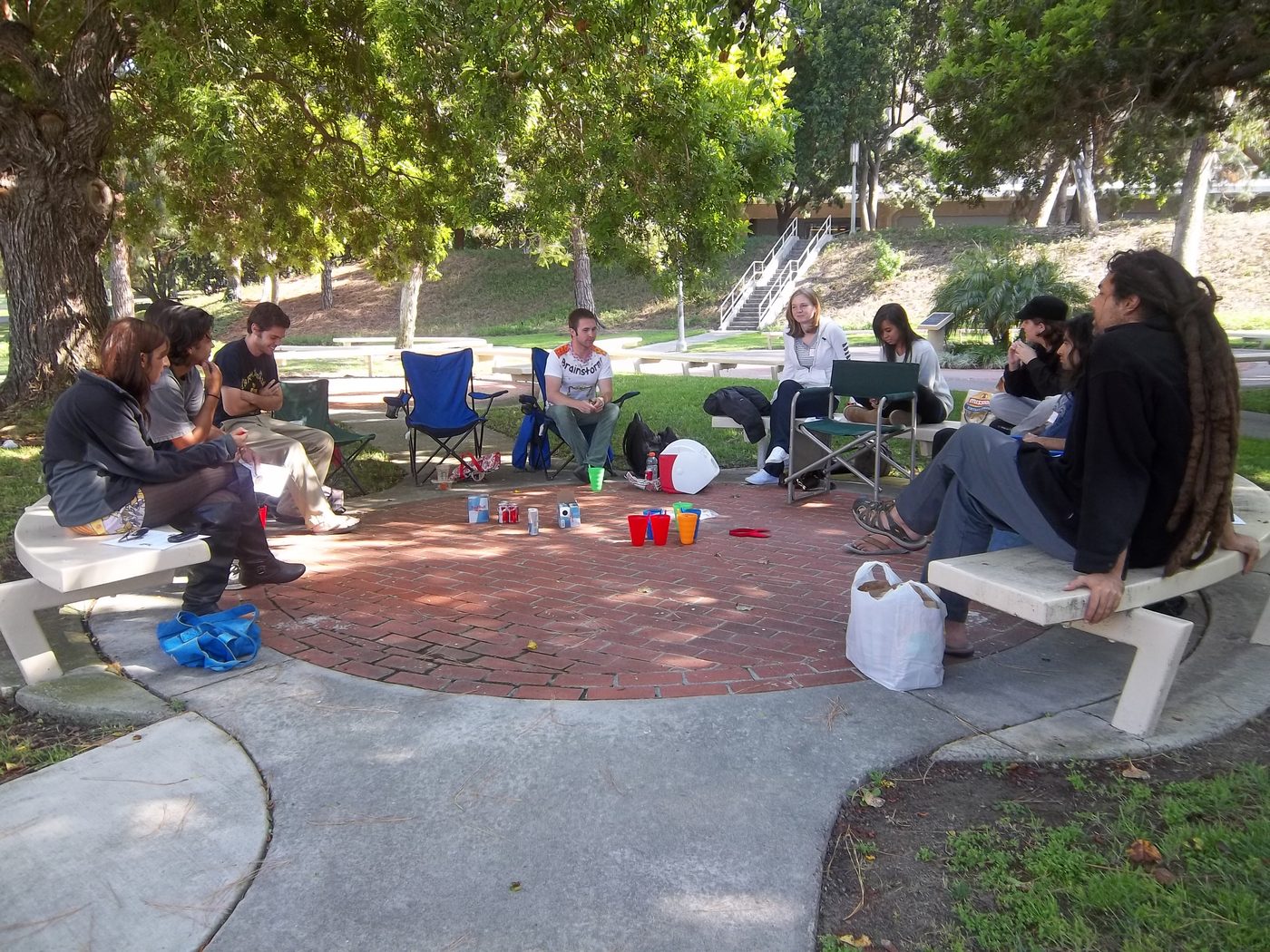
As an undergraduate at UC Irvine I put the second star to work: I founded Brainstorm, a weekly philosophy and open-mindedness club that brought together students of every worldview for free-flowing conversations and epic camping trips.

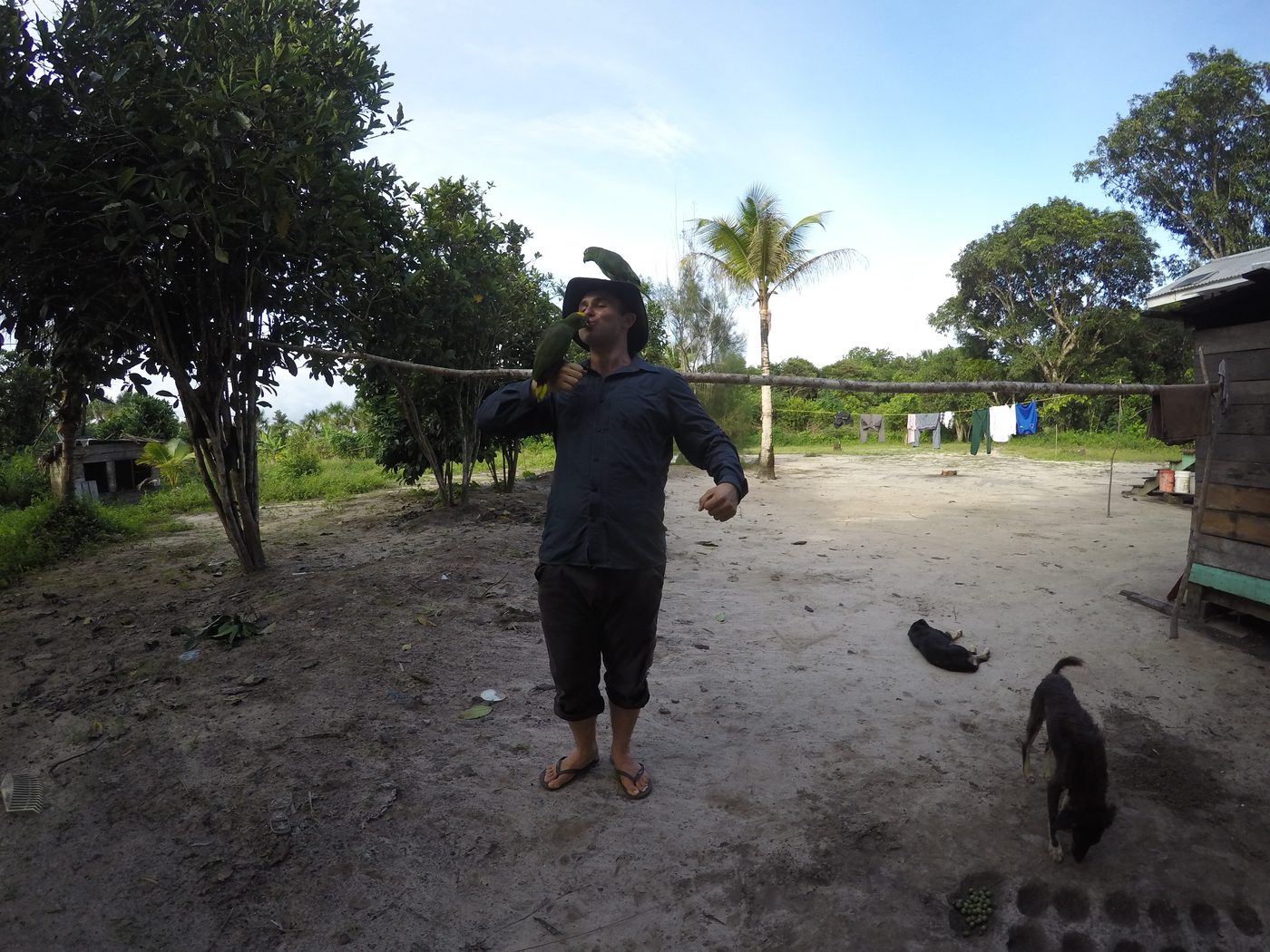
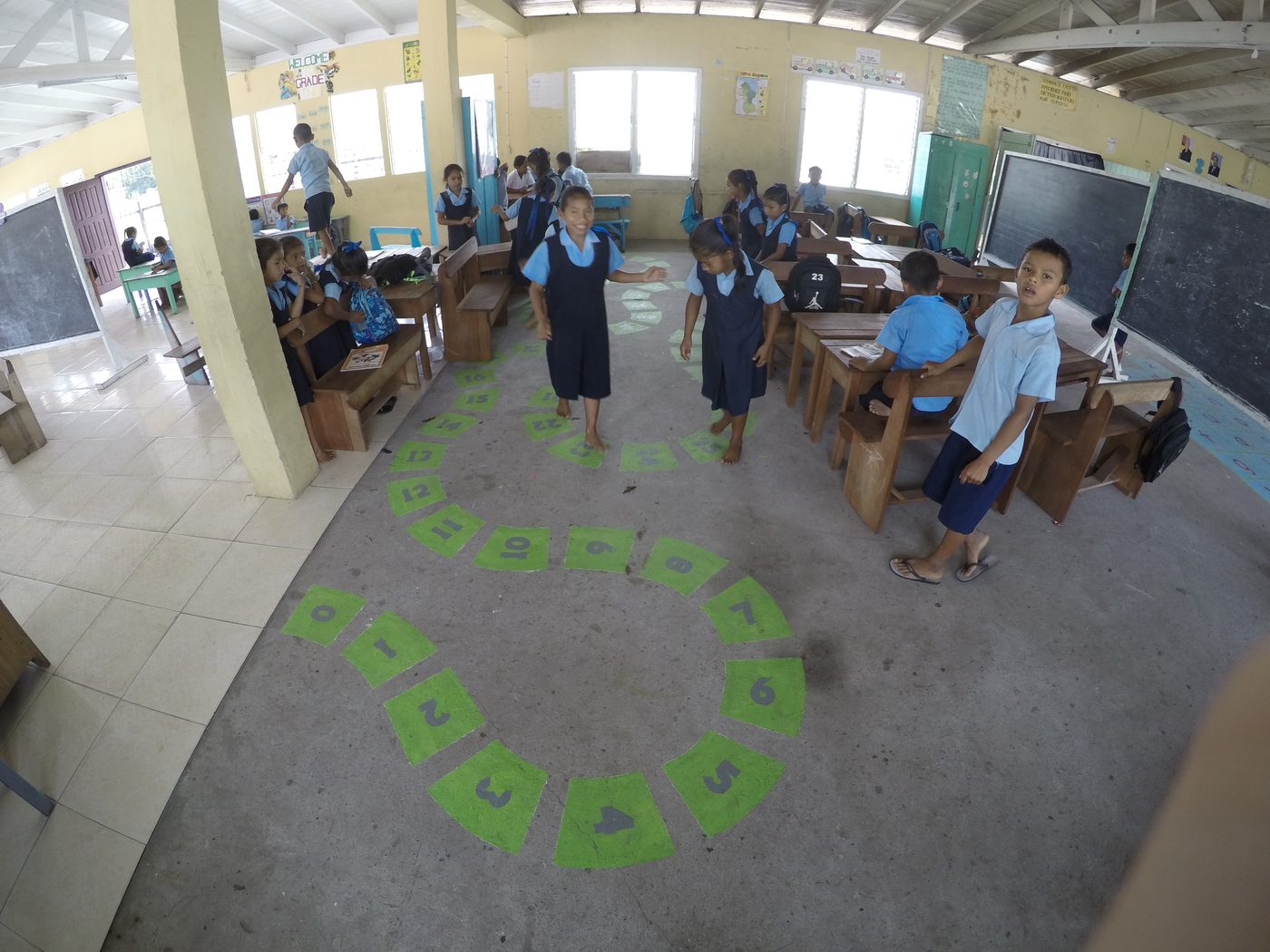
Between college and graduate school I spent seven years seeking novelty and adversity. I herded goats on a farm in Maine, taught preschool through story-based lessons, hiked 1,000 miles of the Appalachian Trail, taught English in Hanoi, and served as a Peace Corps education volunteer in an Indigenous community in Guyana, paddling a dugout canoe from school to school to teach literacy and train teachers.

During my service I saw a school-farm project fail due to free-riding: the tragedy of the commons. The community had plenty of capable farmers and plenty of children who needed better nutrition; what it lacked was cooperation. That left an impression on me, and I wanted to learn how to prevent similar failures in the future.

These days I live in the Seattle area with my amazing wife, Rose, and our hilarious son, Atlas.